🛒 Magento vs WooCommerce vs Shopify — Which E-Commerce Platform Should You Build On?
A simple go to for building e-commerce platforms

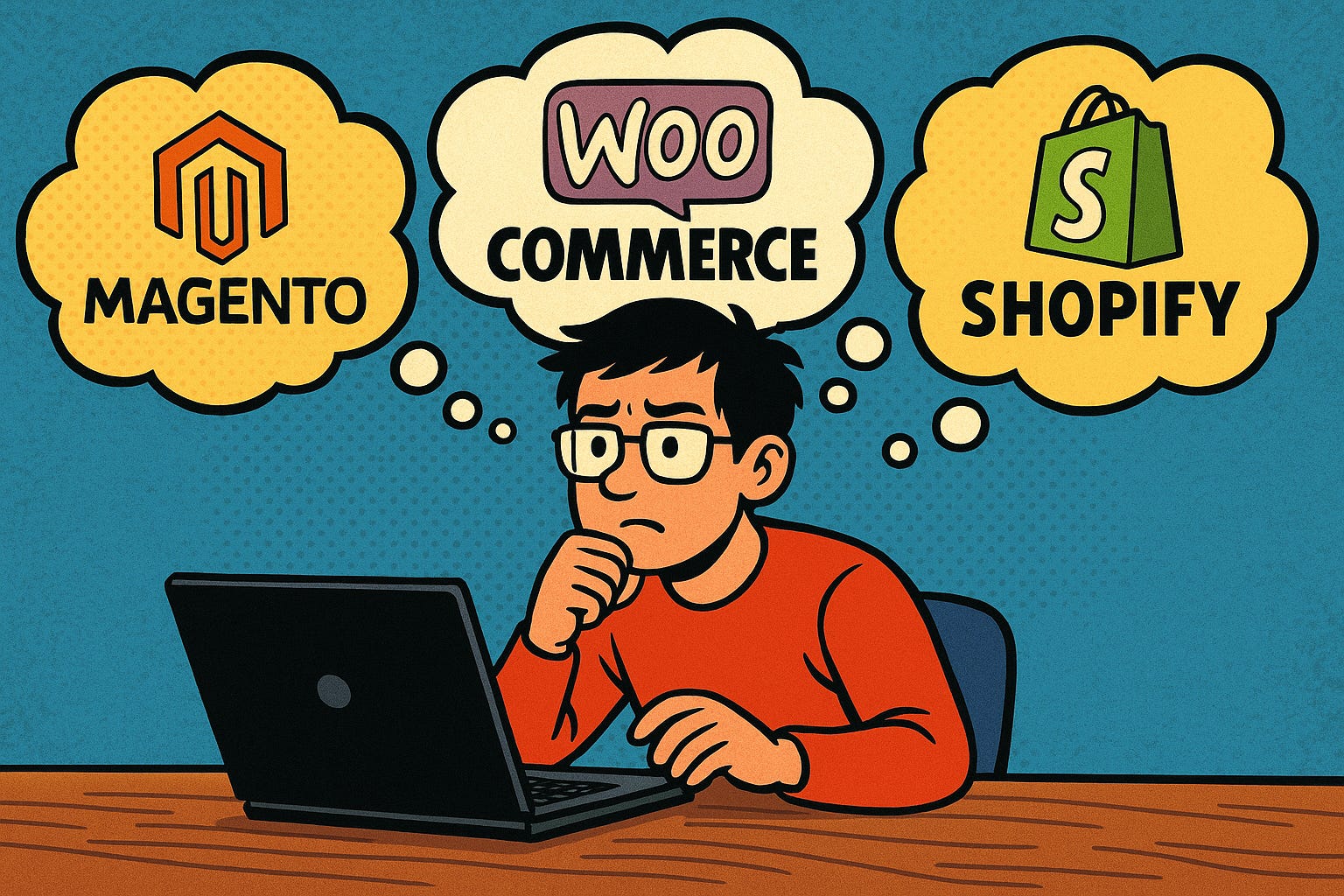
🛒 Magento vs WooCommerce vs Shopify — Which E-Commerce Platform Should You Build On?
Launching an online store today has never been easier — but choosing the right platform is still one of the biggest decisions a founder will make.
Your choice affects:
💰 Cost to launch and cost to scale
⚙️ How much control you have over features, data, and code
🚀 How fast you can go live and start selling
🔒 Security, performance, and compliance as you grow
🧱 Whether you’re building a small shop, a brand, or a full commerce tech stack
Three of the most common platforms founders consider are:
✅ Shopify – Hosted SaaS, fastest to launch, beginner-friendly
✅ WooCommerce – WordPress-based, open-source, content + commerce
✅ Magento (Adobe Commerce) – Enterprise-grade, highly customizable, scalable
Each is powerful — but only when used in the right context.
Let’s break down how to choose the best fit.
🟩 Shopify
Best for: Solo founders, fast launch, DTC brands, subscription or dropshipping models
Why people choose Shopify:
No hosting, servers, or DevOps — Shopify runs everything
App marketplace lets you add features instantly (upsell, subscriptions, analytics, loyalty, etc.)
Themes and page builders mean you don’t need a developer to start
Built-in checkout is optimized for conversion and mobile
Can scale into high-volume stores via Shopify Plus
Trade-offs:
Limited backend control (you don’t own the platform)
Custom logic and workflows often require apps or expensive dev work
Transaction fees unless you use Shopify Payments
Data portability is limited if you ever want to migrate out
Typical cost:
$29 – $399/month + app fees + 2–3% transaction fees
Shopify Plus: starts at $2,000/month
✅ Great for: MVP stores, digital brands, influencers, low-to-medium complexity shops
❌ Not ideal for: Deep customization, B2B pricing systems, multi-warehouse logic
🟨 WooCommerce (WordPress)
Best for: Brands built around content + commerce, SEO-heavy businesses, teams already using WordPress
Why people choose WooCommerce:
100% open-source — you own the code, data, hosting
WordPress + WooCommerce = strong SEO and blogging power
Huge plug-in ecosystem (payments, shipping, subscriptions, CRM, etc.)
No platform transaction fee — only payment gateway fees
Much easier to customize than Shopify if you have a developer
Trade-offs:
You manage your own hosting, security, performance, backups
Plugin overload can lead to site speed issues or security holes
Needs technical maintenance (updates, patches, staging, etc.)
Scalability depends on hosting architecture, not the platform itself
Typical cost:
Hosting + themes + plugins + dev time → $50–$500/month real-world
(“Free” only applies if you DIY everything)
✅ Great for: Content-led brands, education-based sellers, founder-run stores
❌ Not ideal for: Enterprise scale, multi-store setups, non-technical founders
🟥 Magento (Adobe Commerce)
Best for: Enterprise commerce, B2B workflows, multi-store, global catalogs, deep customization
Why people choose Magento:
Built for complex catalogs, product rules, multi-currency, multi-warehouse
Full backend customization — every workflow can be modified
UX can be headless (React/Next.js/Mobile app front-end)
Supports wholesale, tiered pricing, custom checkout logic, ERP integrations
Open-source version available, enterprise upgrade path exists
Trade-offs:
Time to market is far longer — weeks to months, not days
Requires a dev team and a hosting strategy (cloud, AWS, Adobe Cloud)
Expensive to maintain — not a “founder-only” platform
Overkill for small DTC brands or simple stores
Typical cost:
Open-source (free) but $2K–$10K/month for dev + hosting + support
Adobe Commerce license: $22K–$125K+/year
✅ Great for: Marketplaces, high-SKU catalogs, enterprise logic, B2B portals
❌ Not ideal for: MVPs, early-stage bootstrapped founders
🔍 Quick Comparison Table
Feature Shopify WooCommerce Magento Hosting Managed SaaS Self-hosted Self-hosted or cloud Ease of setup ⭐⭐⭐⭐⭐ ⭐⭐⭐ ⭐ Customization Low–Medium Medium–High Very High Scalability Good (paid) Depends on hosting Excellent Developer needed? Optional Recommended Required Best for Fast launch, DTC, subscription Content + commerce, SEO Enterprise, large catalogs Cost to launch Low Medium High
🧠 Platform Recommendations by Founder Type
If you want to… Choose Launch fast, validate demand, start selling Shopify Build a brand where the blog + content drives sales WooCommerce Run a wholesale marketplace, multi-store, or multi-currency Magento Minimize tech overhead & focus on marketing Shopify Own your entire codebase, hosting, and data WooCommerce or Magento Start small but scale to enterprise later Shopify → Shopify Plus Build a highly engineered commerce platform from day 1 Magento
✅ Recommended Path for Most Early-Stage Startups
If you’re pre-product-market-fit:
Start with Shopify. Prove the business first.
If you’re building a media + commerce hybrid (blog + shop):
WooCommerce is a strong long-term play.
If you’re building a commerce-driven company, not just a store — e.g. B2B pricing engines, multi-vendor marketplace, logistics workflows:
Magento or a fully headless architecture is the right long game.
📌 Want Templates, Checklists, or Architecture Examples?
If you want, I can share:
✅ A platform decision worksheet (PDF)
✅ A launch checklist for Shopify, WooCommerce, and Magento
✅ A 3-year cost-of-ownership comparison
✅ Architecture diagrams (MVP vs Scale)
✅ A “Shopify → Magento migration path” guide
Comment or reply if you’d like me to share them.
💬 If you enjoyed this breakdown…
📰 Subscribe for more founder-centric breakdowns on product, tech, and go-to-market
💡 Share this post with another founder choosing an e-commerce stack
🛠️ Reply if you want help deciding based on your specific business model
Next Topic Ideas (vote in comments)
“How to validate an e-commerce idea in 10 days without writing code”
“What metrics matter most for early-stage e-commerce?”
“Shopify tech stack: the 10 most useful apps for founders”
“How AI is changing product discovery and shopping behavior”